

The Power of Scenarios (and Why Content Alone Isn’t Enough)
Most training tells people what to do.
Very little training helps people decide what to do when it matters.
That’s where scenarios earn their place.
Why scenarios work when other training doesn’t
In real work, people rarely fail because they don’t know the rules.
They struggle because:
situations are messy
pressure is real
context changes
decisions have consequences
Scenarios mirror that reality.
Instead of asking learners to remember information, scenarios ask:
“What would you do here?”
And that single shift makes all the difference.
What scenarios actually are (in plain English)
Scenarios are practice environments.
They put people into realistic situations where they must:
interpret what’s happening
make a decision
experience a consequence
reflect and try again
This is why they’re so effective for:
judgement
confidence
problem-solving
behaviour change
They don’t replace content they replace guesswork.

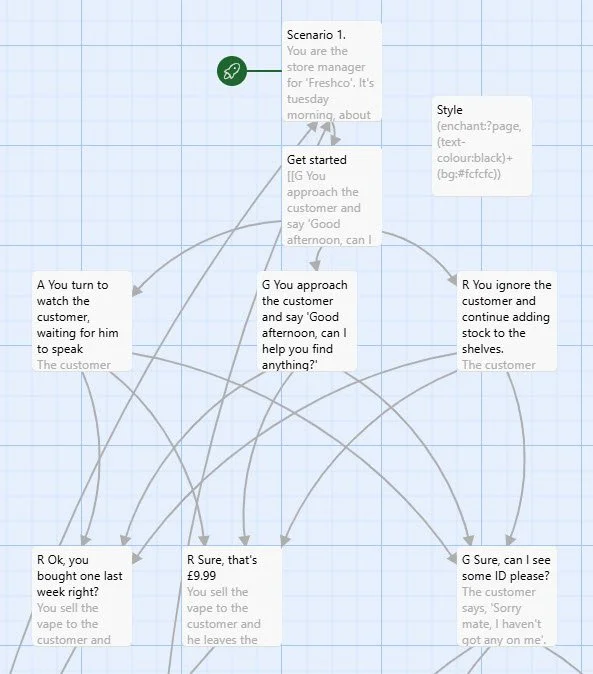
Example of a branching scenario following compliance legislation.
The learner makes a choice and the story changes.
The four types of scenarios (and when to use them)
Not all scenarios are equal. Choosing the wrong type is a fast way to waste effort.
1. Linear scenarios
Best when:
there’s a fixed process
sequence matters
errors carry risk
Think safety steps, compliance flows, or critical procedures.
2. Branching scenarios
Best when:
decisions matter
different choices lead to different outcomes
judgement is the skill
Ideal for customer service, management decisions, compliance judgement calls.
3. Explorative scenarios
Best when:
learners need to understand a system or environment
discovery matters more than sequence
Useful for software, processes, or situational awareness.
4. Role-based scenarios
Best when:
perspective matters
empathy is part of performance
communication is key
Often powerful in leadership and people-management learning.
The mistake many businesses make?
Using complex scenarios where clarity would do or vice versa.

An e-learning which enabled learners to choose the actions and order undertaken.
Why scenarios make learning stick
Scenarios work because they align with how people actually learn at work.
They:
create emotional engagement
make consequences visible
improve recall through experience
reduce risk by allowing safe failure
As Cathy Moore puts it, scenarios show learners what good performance looks like, instead of telling them.
And that difference shows up on the job.

Where scenarios often go wrong
Scenarios fail when:
they’re bolted onto weak objectives
they test memory, not judgement
they exist “because they’re engaging”
they aren’t tied to real performance problems
A beautifully built scenario that doesn’t map to real work is just expensive theatre.
Scenarios don’t fix bad questions
Before adding scenarios, the real question is:
What behaviour are we trying to change?
If that isn’t clear:
scenarios won’t help
branching will confuse
learners will disengage
This is why scenarios should come after clarity, not before design.
This is where Define & Align matters
Scenarios are most effective when they are:
targeted
purposeful
tied to real decisions
That clarity comes from Define & Align.
It helps you:
identify the real performance problem
decide whether scenarios are needed at all
choose the right type of scenario
avoid over-engineering learning
Sometimes scenarios are the answer.
Sometimes simpler support works better.
Define & Align helps you tell the difference.
A final sense-check
If your training relies on:
people remembering information
hoping they’ll apply it later
assuming confidence will follow completion
Scenarios may be exactly what’s missing.
But only when they’re built on the right foundations.
👉 Define & Align helps you decide what to practise and why before investing in building it.
Because performance doesn’t improve through content. It improves through practice, clarity, and good decisions.