

Why I Don’t Use Video in SkillSmart Courses
(And why that’s very deliberate)
Most short online courses today look something like this:
a series of videos
a transcript underneath
maybe a workbook or a few templates to download
Essentially:
watch me talk → read along → download things → job done.
And look I get it.
I’ve bought those courses too.
I’ve even “done” them while answering emails in the background.
But here’s the thing:
That’s not how behaviour changes.
So I made a deliberate choice with SkillSmart.
I don’t use video as the backbone of the courses.
In fact, most SkillSmart courses have little to no audio at all.
Not because I can’t use video.
Because I choose not to.

Training isn’t entertainment (and that’s okay)
Somewhere along the way, training started trying very hard to be entertaining. ‘lets make it like netflix’….
High-energy videos.
Polished presenters.
Cinematic intros.
And again, there’s nothing wrong with that.
But entertainment is not the same thing as learning.
And learning is not the same thing as doing.
You can:
watch a video
nod along
feel motivated
…and still change absolutely nothing about how you work tomorrow.
That’s not a failure of the learner.
It’s a design problem.
SkillSmart courses aren’t podcasts or audiobooks
SkillSmart courses are not designed to be:
listened to while driving
played in the background
consumed passively
They’re not podcasts.
They’re not audiobooks.
They are working courses.
Every section exists for one reason:
👉 to get you to do something specific.
That might be:
mapping a real issue in your team
making a decision you’ve been avoiding
testing a small change in how you work
having a different conversation
If you’re watching a video, you’re usually not doing.
And doing is the point.
“But people like video…”
Yes.
People also like scrolling.
That doesn’t mean scrolling builds skills.
Video is brilliant when:
you’re demonstrating a physical task
you’re modelling behaviour
you need to show tone, body language, or environment
But for thinking work: decision-making, prioritisation, problem-solving, skill-building…
reading, reflecting, and acting beats watching every time.
SkillSmart is designed to slow you down just enough to think… and then nudge you into action.
The design choice most current courses avoid
Every SkillSmart course is built around:
short, focused inputs
clear prompts
structured tasks
intentional friction
Not “watch this next”.
But:
pause
decide
write
try
You absolutely could read a SkillSmart course and take no action.
But every page makes that choice visible.
And that’s intentional.
Because behaviour change doesn’t happen by accident.
It happens when learning is designed to demand something of you.
Less passive. More practical.
This approach isn’t flashy.
It doesn’t lend itself to:
binge-watching
background listening
ticking a box
But it does lend itself to:
clarity
momentum
follow-through
And for the SMEs, managers, and teams I work with that matters far more than entertainment and polish.
If you’re used to video-heavy courses…
SkillSmart might feel different at first.
Quieter.
More hands-on.
A little more demanding.
That’s the point.
Because training that fits neatly around everything else often changes nothing at all.
Want to see what that looks like in practice?
If you’re curious about learning that’s designed for doing, not watching, you can explore the SkillSmart courses here.
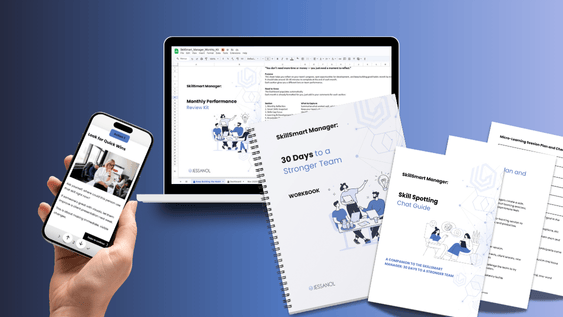
They’re short.
They’re practical.
And they’re built to change what happens after the course, not just during it.